What Happens During a Workplace Safety Assessment?
What happens during a workplace safety assessment is straightforward: an assessor takes a structured look at your premises, work activities and paperwork to find what could cause harm, who could be hurt and whether your current controls are good enough. Done properly, it ends with a written record of the significant findings and a prioritised action plan that you can actually work through. It is not a one-off pass or fail.
If you have never had one, or the last one was carried out by someone who has since left, this guide explains what happens on the day, how to prepare and what you should expect to receive.
Key facts
- Under the Management of Health and Safety at Work Regulations 1999, every employer must carry out a suitable and sufficient assessment of the risks to employees and others affected by their work.
- If you employ five or more people, you must record the significant findings.
- Fire, hazardous substances and noise have their own assessment duties, under the Regulatory Reform (Fire Safety) Order 2005, COSHH and the Control of Noise at Work Regulations 2005.
- Employers must appoint competent help to meet their health and safety duties. That can be in-house or an external consultant.
- An assessment should be reviewed when something significant changes, such as new equipment, a new process, an incident or a change in staff.
Before the visit: what to prepare
The more the assessor sees up front, the more useful the assessment will be. Before we visit a site, we usually ask for:
- Your current health and safety policy and any existing risk assessments, however old.
- A list of the main work activities, machinery, vehicles and substances in use.
- Accident book entries, near-miss reports and any recent incidents.
- Training records, especially for higher-risk tasks like lift truck operation, work at height and first aid.
- Maintenance and inspection records for equipment such as forklifts, racking, extraction and fire alarms.
- Details of anyone who may be at greater risk, such as young workers, new or expectant mothers, lone workers and contractors.
Missing documents are not a problem. Finding gaps is part of the job. Just tell the assessor what is missing rather than leaving them to discover it.
On the day: what happens during a workplace safety assessment
A good safety assessment is not completed from behind a desk. Expect three strands of work.
1. A walk round the site
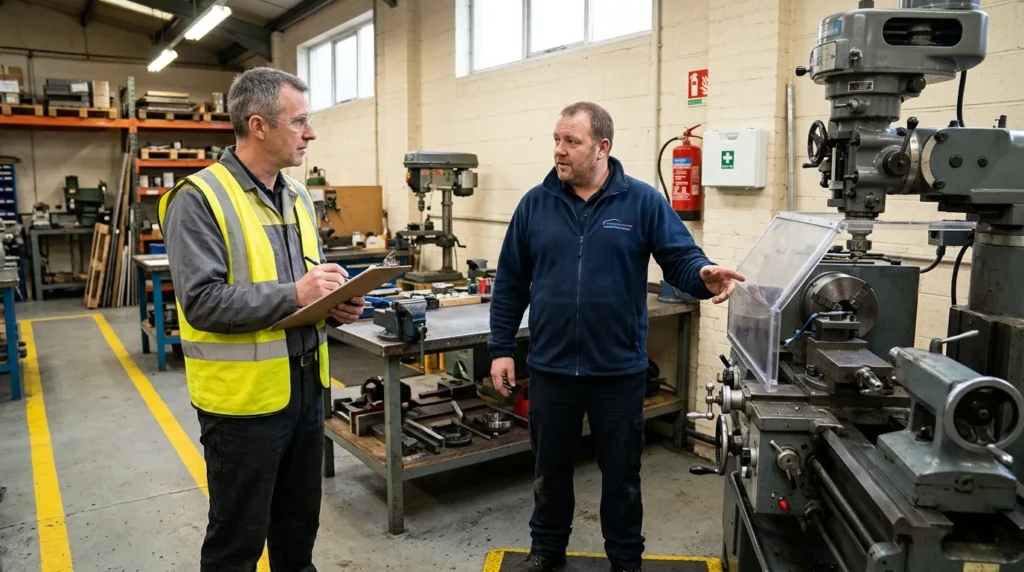
The assessor will walk the premises with someone who knows the operation. They look at traffic routes and pedestrian segregation, storage and racking, machinery guarding, housekeeping, fire exits and signage, welfare facilities, and how chemicals are stored and handled. They will ask to see tasks being done as they are really done, not as the procedure says they should be.
2. Talking to people
Supervisors and operators often know where the real risks are. Expect the assessor to ask staff how they carry out tasks, what goes wrong, and what they would change. Involving staff is also part of your legal duty to consult employees on health and safety.
3. Checking the paperwork against reality
The assessor compares what your documents say with what they have seen. A written procedure that nobody follows, or a risk assessment that describes equipment you no longer use, is a common finding.
What you should receive afterwards
The output matters more than the visit. As a minimum, you should get:
- A written assessment covering each significant hazard, who could be harmed, the existing controls and any further action needed.
- A prioritised action plan, so you know what to deal with first and what can be scheduled.
- Clear recommendations on any specialist assessments needed, for example fire, COSHH, noise, manual handling or display screen equipment.
- A sensible review date.
If you receive a generic template with your company name added, push back. An assessment must be specific to your site and your work to be suitable and sufficient.
Does a general safety assessment cover chemicals and fire?
Not fully. A general assessment will flag where hazardous substances or fire risks exist, but each has its own detailed assessment duty. If staff use cleaning products, solvents, dusts or fumes, you will also need a COSHH assessment for those substances. Fire needs its own fire risk assessment under the Fire Safety Order.
People searching for a chemical safety assessment in the UK are sometimes looking for something different again: the formal chemical safety assessment that manufacturers and importers of substances may need under UK REACH. That is a regulatory product dossier, not a workplace assessment. For most employers using chemicals at work, COSHH is the relevant duty.
What happens next
The assessment is only useful if the actions get done. In practice, that means:
- Assigning each action to a named person with a target date.
- Sharing the findings with the staff affected and briefing them on any changed controls.
- Arranging any training the assessment identified.
- Keeping the record somewhere it can be found, for example if an HSE or local authority inspector visits.
- Revisiting it when something changes, rather than waiting for the review date.
No assessment guarantees that nothing will go wrong. What it does give you is a clear, defensible picture of your risks and a plan to control them.
FAQ
Do I legally need a written safety assessment?
Every employer must assess risks. If you employ five or more people, you must record the significant findings. Even below that threshold, a written record is the simplest way to show what you have considered and done.
Can I do the safety assessment myself?
Yes, if you are competent to do it, meaning you understand the hazards, the law and the controls that apply to your work. Many smaller businesses bring in a consultant for the first assessment, or for higher-risk activities, then maintain it in-house.
How often should a safety assessment be reviewed?
The law does not set a fixed interval. It should be reviewed whenever there is reason to think it is no longer valid, such as new equipment, new processes, an accident or near miss, or significant staff changes. Many businesses also set a regular review date as good practice.
Will the assessor stop work if they find a problem?
A consultant is there to advise you, not to enforce. If they find something serious, they will tell you straight away so you can act. Decisions about stopping work remain yours as the employer.
Arrange a safety assessment in Norfolk
Milne Safety has supported employers since 1978 from our base in Wymondham, working with businesses across Norwich, Attleborough, Thetford, Dereham and beyond. Our senior consultants hold Chartered Membership of IOSH, and we carry out each workplace safety assessment on your own site, so it reflects how your business really works. Any training the assessment identifies can be delivered at our Wymondham training centre or on your premises.
To discuss an assessment or our wider health and safety consultancy, call us on 01953 607093 or contact us for a quote.