HSE Crackdown on Respiratory Risks: COSHH Risk Assessment
Last reviewed: 26 October 2026. Figures and rules can change – always confirm on the official links.
The HSE crackdown on respiratory risks means tougher enforcement on dust and fumes: dry cutting of engineered stone is now unacceptable, more than 1,000 engineered stone inspections are under way, and employers are being fined in court. In 2026 a food manufacturer was fined £120,000 after workers were exposed to dust levels causing occupational asthma. Two sister companies were fined a total of £34,000 plus £7,809.30 costs at Norwich Magistrates Court for exposing workers to wood dust.
If your COSHH risk assessment does not properly cover dust, fumes, RPE and health surveillance, would it survive an HSE visit?
Key facts
- HSE announced a major enforcement package on 11 May 2026, with over 1,000 engineered stone inspections running through the 2026/27 period.
- Dry cutting of engineered stone has been declared unacceptable. Water suppression is confirmed as a legal requirement.
- HSE has been inspecting large bakeries across Great Britain since January 2026. Flour dust is one of the most common causes of occupational asthma in Great Britain.
- On 3 July 2026 HSE issued its first-ever Prohibition Notice against an occupational health service provider.
- Fines in 2026 include £120,000, £34,000 plus £7,809.30 costs, £30,000 and £27,200.
Engineered stone: no more dry cutting
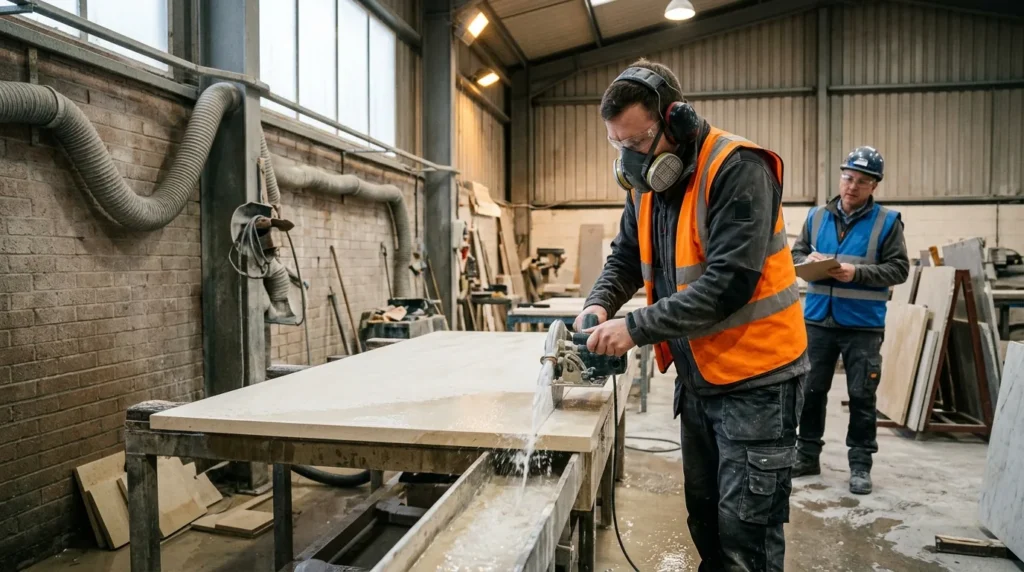
On 11 May 2026 HSE confirmed that dry cutting of engineered stone is unacceptable. Engineered stone contains up to 95% crystalline silica. Exposure can cause silicosis in months or years. With natural stone it takes decades.
HSE scientists found that dry fabrication produces respirable crystalline silica (RCS) exposure 5-10 times higher than wet methods. HSE has also published its first-ever COSHH guidance sheet for engineered stone. It requires four things:
- a switch to low silica content stone
- on-tool water suppression
- appropriate RPE
- regular health surveillance
By the end of May 2026, four enforcement notices had already been served in the nationwide campaign.
HSE crackdown on respiratory risks: dust and fume cases that ended in court
Engineered stone is not the only target. Recent HSE cases show the same failings across food, timber and metalwork:
- A food manufacturer fined £120,000 over hazardous dust exposure. Workers at its Buckingham factory were exposed to dust levels causing occupational asthma. An HSE inspection on 3 December 2024 found unsafe practices. Monitoring on 18 December 2024 confirmed exposure above workplace exposure limits.
- Two sister companies sentenced at Norwich Magistrates Court. On 18 September 2026 they were fined a total of £34,000 plus £7,809.30 costs for exposing workers to wood dust.
- A Cornwall sawmill company. Its staff were not face fit tested for their RPE and were not under suitable health surveillance.
- A skip manufacturer fined £30,000 in June 2026 for exposing welders to cancer-causing fumes without ventilation or protective equipment. It had failed to act on improvement notices from September 2024 and February 2025.
- A Bedfordshire engineering firm fined £27,200 in January 2026 for poor control of metalworking fluids. Workers were put at risk of dermatitis, asthma and respiratory conditions.
The pattern is the same in every case. The hazard was known, and the controls, monitoring or surveillance were not in place.
Health surveillance itself is under scrutiny
Paying someone to do health surveillance is not enough. On 3 July 2026 HSE took landmark enforcement action against an occupational health service provider. The provider was delivering health surveillance through inadequately trained, unqualified and unsupervised personnel. HSE said early signs of occupational asthma, dermatitis and noise-induced hearing loss were at risk of going undetected.
Do you know who carries out your workers’ lung function or skin checks, and what qualifications they hold?
The limits you are measured against
Exposure to RCS falls under the Control of Substances Hazardous to Health Regulations 2002 (COSHH). The current workplace exposure limits (8-hour time-weighted average) are:
- Respirable crystalline silica: 0.1 mg/m³
- Hardwood dust: 3mg/m³
- Softwood dust: 5mg/m³
Health surveillance must be provided to workers regularly exposed to RCS dust where there is a reasonable likelihood that silicosis may develop. Ongoing assessments should be carried out at appropriate frequencies, usually annually, and should involve a questionnaire and spirometry. For stone worktop installation, an FFP3 mask with an assigned protection factor of at least 20 is required. That can reduce the dust breathed in by a factor of 20.
What this means for employers in Wymondham, Norwich and Norfolk
Bakeries, joinery workshops, sawmills, fabrication shops and food producers in Wymondham, Norwich, Attleborough, Thetford and Dereham all deal with dust or fumes. The Norwich case shows these prosecutions are not happening somewhere else. If your workers breathe dust or fumes, you should do the following now:
- Review your COSHH risk assessment for every dust, fume and mist your processes create, including wood, flour, silica, welding fume and metalworking fluids.
- Check your controls. That means water suppression, extraction and ventilation, not RPE alone.
- Face fit test every tight-fitting mask wearer. Our face fit testing service covers this.
- Put exposed workers under suitable health surveillance, such as lung function testing, carried out by competent people.
- Act promptly on any improvement notice. Two of the cases above escalated after notices were not acted on.
Compare the cost of getting this right with the cost of getting it wrong. A COSHH review, fit testing and surveillance cost far less than a £120,000 fine, legal costs and the damage a prosecution does to your reputation.
Frequently asked questions
Is dry cutting of engineered stone still allowed?
No. HSE has declared dry cutting of engineered stone unacceptable. Water suppression is confirmed as a legal requirement.
Which workplaces is HSE inspecting?
More than 1,000 inspections of engineered stone work are running through 2026/27. HSE has also been inspecting large bakeries across Great Britain since January 2026.
How often should silica-exposed workers have health surveillance?
Ongoing assessments should be carried out at appropriate frequencies, usually annually, and should involve a questionnaire and spirometry.
What RPE is needed for stone worktop installation?
An FFP3 mask with an assigned protection factor of at least 20. It must fit the wearer, which is why face fit testing matters.
Get your respiratory controls reviewed
Milne Safety has supported Norfolk employers since 1978. Our CMIOSH-qualified consultants can review your COSHH risk assessment and exposure controls. We provide face fit testing, lung function and skin surveillance, and IOSH training at our Wymondham training centre or on your own site. Read more about our health and safety consultancy, or call us on 01953 607093 to arrange a review before HSE arranges one for you.