New Health and Safety Legislation and Regulation Changes Taking Effect
Last reviewed: 19 October 2026. Figures and rules can change – always confirm on the official links.
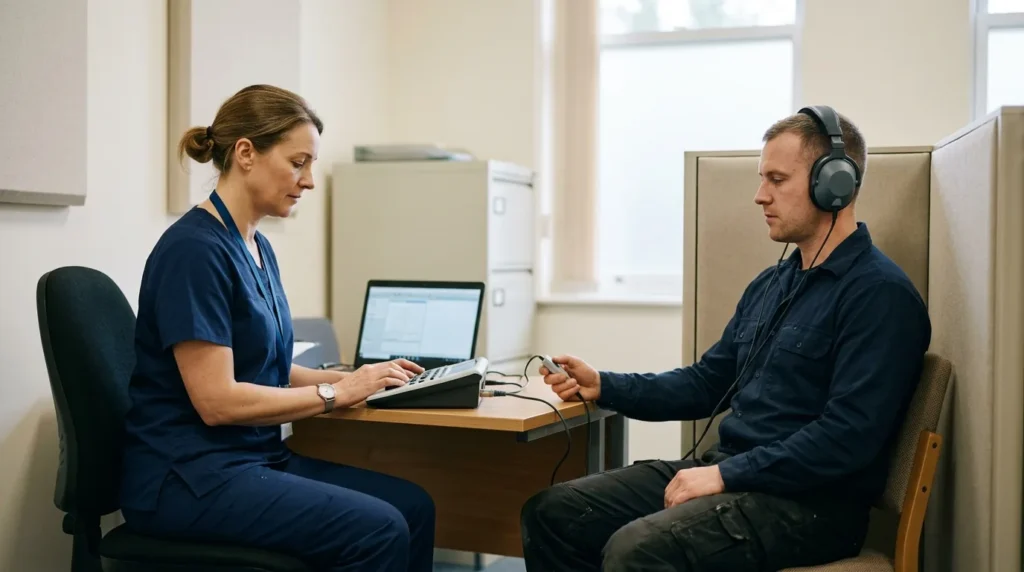
New health and safety legislation and regulation changes taking effect in 2026 include a landmark enforcement shift: in July 2026 the Health and Safety Executive issued its first-ever Prohibition Notice against an occupational health service provider, finding that inadequate health surveillance was putting workers at risk of serious and irreversible harm. The provider was delivering surveillance through personnel who were inadequately trained, unqualified and unsupervised. If you outsource audiometry, lung function or skin checks, that notice should stop you in your tracks: ineffective surveillance meant early signs of occupational asthma, dermatitis and noise-induced hearing loss were at risk of going undetected.
Key facts at a glance
- HSE issued its first-ever Prohibition Notice against an occupational health service provider in July 2026.
- The finding: inadequate health surveillance delivered by personnel who were inadequately trained, unqualified and unsupervised.
- The risk: early signs of occupational asthma, dermatitis and noise-induced hearing loss going undetected.
- Separately, in January 2026 an NHS Trust was fined £40,000 after employees developed serious and irreversible hand-arm vibration-related conditions following failures to assess and control vibration exposure.
- In January 2026 an engineering firm was fined £27,200 for poor control of metalworking fluids, putting workers at risk of dermatitis, asthma and respiratory conditions after failing to comply with HSE Improvement Notices.
New health and safety legislation and regulation changes taking effect: why this is a turning point
Until now, enforcement attention on occupational health focused on the employer who failed to arrange surveillance. This notice turns the lens on the quality of the surveillance itself. HSE has made clear that buying in a health surveillance service does not transfer the duty to protect workers, and that a service delivered badly is no better than no service at all. If you commissioned audiometry or skin checks believing you were covered, the obvious question is: who actually carried them out, and were they competent?
Health surveillance exists to catch occupational ill health early, while it is still reversible or before it worsens. When it is done by someone unqualified and unsupervised, the whole point collapses. Workers keep being exposed. The conditions progress. And the paperwork that was supposed to prove diligence becomes evidence of failure.
The wider enforcement picture in 2026
This sits alongside a run of occupational-health prosecutions that should worry any employer with noise, dust, vibration or chemical exposures. HSE reported that in January 2026 an NHS Trust was fined £40,000 after employees developed serious and irreversible hand-arm vibration-related conditions, following failures to assess and control vibration exposure. In the same month an engineering firm was fined £27,200 for poor control of metalworking fluids, exposing workers to dermatitis, asthma and respiratory conditions, having failed to comply with HSE Improvement Notices.
HSE has also been active on the respiratory front. From January 2026 it began inspecting large bakeries across Great Britain to check employers are protecting workers from flour dust; in July 2026 a bakery ingredients manufacturer was fined £120,000 after workers at a Buckingham factory were at risk of developing occupational asthma. And in May 2026 HSE confirmed that dry cutting of engineered stone is unacceptable and water suppression is a legal requirement, with over 1,000 inspections underway and four companies ordered to stop work in June 2026 after failing safety inspections. You can read HSE’s own reporting on the HSE prosecutions newsroom.
What this means for employers in Norfolk
If you employ people exposed to noise, dust, vibration, chemicals or skin irritants anywhere around Wymondham, Norwich, Attleborough, Thetford or Dereham, the duty to provide effective health surveillance is yours and stays yours. Under section 2 of the Health and Safety at Work etc. Act 1974, you must ensure, so far as is reasonably practicable, the health of your employees. That includes making sure any surveillance you arrange is actually fit for purpose.
The practical steps:
- Check who delivers your health surveillance and confirm they are trained, qualified and supervised for the tests they carry out.
- Match the surveillance to the actual exposures in your risk assessment – audiometry for noise, lung function for dust and respiratory sensitisers, skin checks for dermatitis risks, face fit for RPE.
- Make sure results are reviewed, acted on and fed back into your controls, not just filed.
- Keep your COSHH, noise and vibration assessments current, so the surveillance programme reflects today’s reality on the floor.
- Respond to any Improvement Notice promptly – two of the fines above involved firms that did not.
How we can help
We have run occupational health and safety services from our Wymondham base since 1978. Our in-house health surveillance covers lung function testing, skin surveillance, audiometric testing and face fit testing, and our senior staff hold CMIOSH and MIIRSM. We can also review your underlying risk and COSHH assessments so your surveillance programme targets the right exposures. Testing is delivered at our Wymondham training centre or on your site across Norfolk.
Frequently asked questions
Does outsourcing health surveillance transfer my legal duty?
No. The July 2026 Prohibition Notice makes the point plainly: the employer’s duty to protect workers remains, and HSE will act where surveillance is delivered by personnel who are inadequately trained, unqualified or unsupervised.
What conditions should health surveillance pick up?
HSE’s finding referenced occupational asthma, dermatitis and noise-induced hearing loss as conditions whose early signs were at risk of going undetected. Which checks you need depends on the exposures in your risk assessment.
What happens if I ignore an HSE Improvement Notice?
Two 2026 cases involved firms that failed to comply with Improvement Notices and were then fined – £40,000 and £27,200 respectively, as HSE reported. Acting on a notice promptly is far cheaper than the alternative.
Do you deliver testing on site?
Yes. We deliver health surveillance at our Wymondham training centre or at your premises across Wymondham, Norwich, Attleborough, Thetford and Dereham.
Would your health surveillance survive an HSE inspection? If you are not certain who is delivering it or whether it covers the right exposures, book a review with us. Call Milne Safety on 01953 607093 or contact us for a quote on surveillance and a compliance review.