Is Reach Truck Training the Same as a Reach Truck Licence?
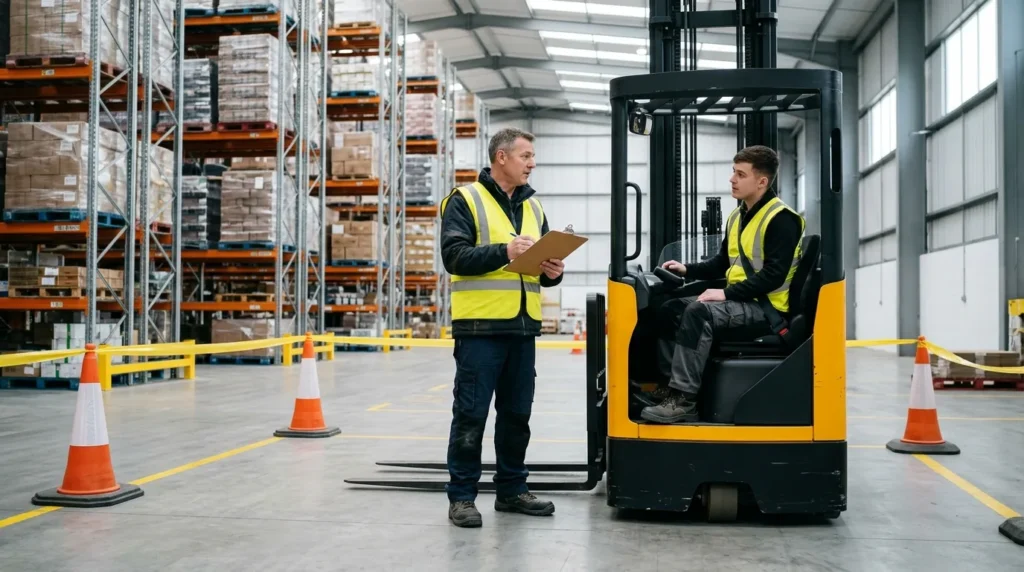
The short answer to ‘is reach truck training the same as a reach truck licence?’ is no: there is no government-issued reach truck licence in the UK, and what people call a licence is really proof of training plus employer authorisation. When people talk about a reach truck licence, they mean two things: a certificate showing the operator has passed basic training with a competent, accredited provider, and written authorisation from their employer to operate that type of truck on that site.
Key facts
- No DVLA-style licence exists for operating a reach truck in a warehouse or yard.
- Employers have a legal duty under PUWER 1998 to make sure anyone using work equipment has adequate training.
- The HSE Approved Code of Practice L117 sets out how rider-operated lift truck operators should be trained, in three stages: basic, specific job and familiarisation training.
- A counterbalance forklift certificate does not automatically cover a reach truck.
- The employer, not the operator, decides who is authorised to drive.
Is reach truck training the same as a reach truck licence?
The word licence has stuck because it is a convenient shorthand. Operators carry a card or certificate, recruiters ask for it, and job adverts list it as a requirement. But that card is evidence of training, not a legal permit. It does not give anyone the right to jump on any reach truck at any site.
This matters for employers. If you assume a new starter is covered because they hold a card from a previous job, you may be relying on training that does not match your trucks, your racking or your working practices.
What the law actually requires
Regulation 9 of the Provision and Use of Work Equipment Regulations 1998 (PUWER) requires employers to make sure people who use work equipment have received adequate training. For lift trucks, HSE explains what adequate looks like in its Approved Code of Practice, L117 Rider-operated lift trucks: operator training and safe use.
L117 describes three stages of training:
- Basic training: the core skills and knowledge needed to operate the truck safely, delivered off the job and followed by a test.
- Specific job training: how to apply those skills to the tasks, loads and attachments in your workplace.
- Familiarisation training: on-the-job training under close supervision, covering your site layout, traffic routes, racking, emergency procedures and site rules.
An Approved Code of Practice has special legal status. If you are prosecuted for a breach of health and safety law and you have not followed the ACoP, you would need to show you complied with the law in some other way that was just as effective. In practice, following L117 is the most straightforward route.
Does a counterbalance certificate cover a reach truck?
No. L117 expects operators to be trained on the type of truck they will use, and a reach truck is a very different machine from a counterbalance forklift. The mast moves forward and back, the operator often sits or stands side-on to the direction of travel, and the work typically involves high racking and narrow aisles where judgement of height, load stability and clearance is critical.
Experienced counterbalance operators do not usually need to start from scratch. Conversion training builds on existing skills and focuses on what is different about the reach truck, followed by a test. Complete novices need full basic training.
What an employer should keep on file
Because there is no central licence register, your records are the evidence that each operator has been properly trained and authorised. For every reach truck operator, keep:
- Their certificate of basic or conversion training, showing the truck type and the provider.
- A record of the specific job and familiarisation training given on your site.
- Your written authorisation, stating which trucks they may operate.
- Notes of any ongoing monitoring, refresher training or reassessment.
L117 does not set a fixed expiry date for training, but it does expect employers to monitor operators and provide refresher training or reassessment where needed, for example after an incident or near miss, when bad practice is spotted, when working methods or equipment change, or when someone has not driven for a long time. Many employers also choose to reassess at regular intervals.
Choosing a reach truck training provider
When you compare providers, ask:
- Is the training accredited? Our lift truck training is accredited by the Association of Industrial Truck Trainers (AITT).
- Will operators be trained and tested on a reach truck, not just a counterbalance?
- Can the training take place on your own site and trucks, so it reflects your racking and layout?
- Does the provider offer novice, conversion and refresher options?
- Will they help you plan the specific job and familiarisation stages that follow?
Our reach truck training is delivered at our training centre in Wymondham or on your premises, for businesses across Norwich, Attleborough, Thetford, Dereham and wider Norfolk. You can also browse our full list of accredited training courses if your team needs other lift truck or safety training at the same time.
Frequently asked questions
Can an operator use their reach truck certificate at a new job?
The certificate shows they have completed basic training, which is useful evidence. But the new employer still needs to check it is relevant to their trucks, give specific job and familiarisation training, and issue their own written authorisation before the operator works unsupervised.
Can reach truck training be done online?
Theory can support learning, but operating a reach truck is a practical skill. L117 expects operators to be trained and tested on the truck itself, so practical training and assessment are essential.
Who is responsible for agency reach truck drivers?
Both the agency and the business using the worker have duties. Agree in writing who checks the operator’s training, and make sure the site provides specific job and familiarisation training and authorisation before they drive.
Do you need a licence to drive a reach truck on a public road?
Reach trucks are designed for warehouse and yard use. If any lift truck is to be driven on a public road, separate road traffic rules apply, so check DVLA requirements before allowing it.
Get your operators trained properly
Since 1978 we have helped Norfolk employers train their people and keep the records to show it. Whether you need novice, conversion or refresher reach truck training, we can run it at our Wymondham training centre or on your own site. Call us on 01953 607093 or use our training booking form to arrange a course.