£4m Fine After Forklift Loading Crush Injury: What It Means
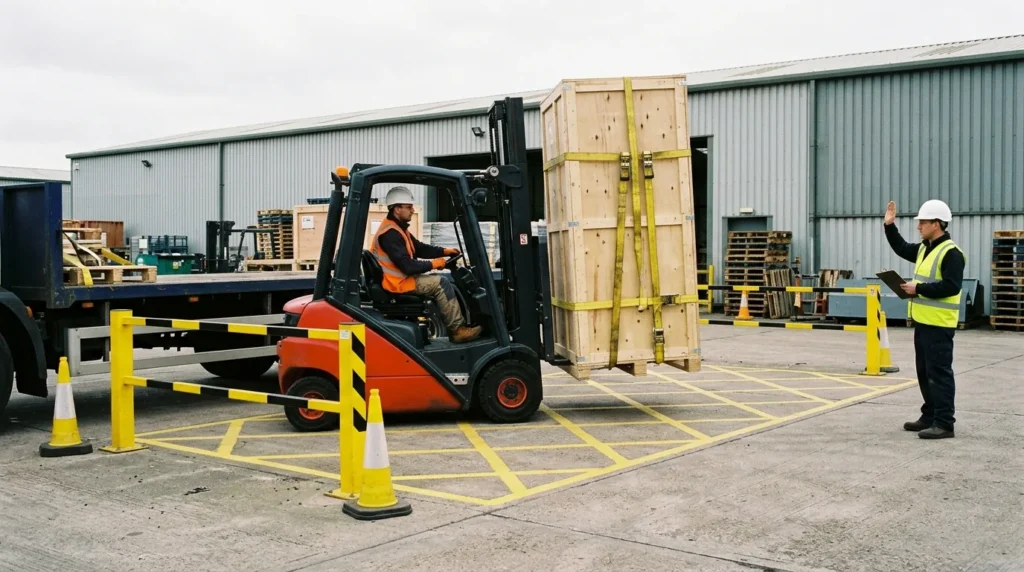
A £4m fine after forklift loading crush injury has been imposed on an electrical wholesaler, plus £6,304 costs, because an unsecured 231kg load fell from a forklift truck onto a worker who was acting as a ‘spotter’ during lorry loading. The 40-year-old father of one suffered brain and spine injuries and now lives in a care home needing 24/7 care. There was no risk assessment and no lift plan, even though this was a regular activity.
If your business in Wymondham, Norwich, Attleborough, Thetford or Dereham loads or unloads vehicles with a forklift, this case is about you. Would your lifting arrangements survive an HSE investigation tomorrow?
Key facts: £4m fine after forklift loading crush injury
- Fine: £4m plus £6,304 costs, Birmingham Magistrates Court, 16 October 2026.
- Incident: 4 October 2024, at an electrical wholesaler’s industrial division in Telford.
- What happened: a 231kg load, not secured to the forklift, fell on an employee acting as a ‘spotter’ while switchboard equipment was loaded onto a flatbed lorry.
- Offence: guilty plea to breaching Section 2(1) of the Health and Safety at Work etc. Act 1974.
- Key failings: no risk assessment, no lift plan, no information or instructions for employees, despite this being a regular activity.
What went wrong
As HSE reported on the £4m electrical wholesaler forklift crush case, the company failed to ensure that the lifting operation was properly planned by a competent person, appropriately supervised and carried out in a safe manner.
The worker was not driving the forklift. He was standing close to it as a ‘spotter’. Employees in that role were expected to steady loads while they were being moved and lifted. HSE described this as an unsafe and unnecessary system of work.
His injuries were catastrophic. He underwent lifesaving surgery, can no longer do anything for himself and is unable to communicate with others.
Safer options were already on site
This is the part that should worry every operations manager. The safer alternatives were not expensive or complicated. According to HSE:
- The load could have been secured to the forklift truck using pre-existing anchor points.
- The load had lifting eyes welded to it, so the crane on the delivery lorry could have been used instead of the forklift.
The equipment existed. What was missing was planning, instruction and supervision. That gap cost £4m and changed a family’s life permanently.
Not an isolated case
Forklift lifting incidents have featured repeatedly in HSE prosecutions over the past year:
- January 2026: a packaging company was fined £433,333 plus £32,500 victim surcharge after a worker suffered a skull fracture when a 4.5-ton machine fell from forklift forks (sentenced 20 January 2026). Read HSE’s report on the packaging company case.
- April 2026: a company was fined £30,000 plus £4,325 costs after a worker was crushed under a one-tonne concrete block during forklift loading. The forklift driver had no training (sentenced 15 April 2026). See HSE’s report on the one-tonne block HGV trailer case.
- May 2026: a machine manufacturing company was fined £170,000 plus £7,999 costs after an employee had two fingers amputated following a forklift lifting operation (sentenced 12 May 2026).
- September 2026: a manufacturer was fined £230,000 plus £111,000 costs after a 64-year-old employee sustained life-changing injuries when a 1.2-tonne crate fell from a forklift truck (sentenced 14 September 2026).
HSE’s message is consistent: loading and unloading operations remain one of the most hazardous transport activities in the workplace.
What the law requires
Under the Lifting Operations and Lifting Equipment Regulations (LOLER), HSE’s LOLER guidance states that:
- All lifting operations involving lifting equipment must be properly planned by a competent person, appropriately supervised and carried out in a safe manner.
- All equipment used for lifting must be fit for purpose, appropriate for the task and suitably marked.
- In many cases, lifting equipment is subject to statutory periodic ‘thorough examination’.
What Norfolk employers should do now
If you run a warehouse, yard, depot or manufacturing site, check these points this week:
- Risk assessment: is every routine loading and unloading task covered by a written, current assessment? A small business risk assessment must reflect what actually happens on the ground, not what the policy says.
- Lift plans: who plans your lifts, and are they competent to do so? ‘We have always done it this way’ is not a plan.
- Securing loads: are anchor points, restraints or lifting eyes being used, or ignored?
- Right equipment: would a crane or other lifting equipment be safer than a forklift for some loads?
- Spotters and banksmen: is anyone being asked to steady a moving load by hand? If so, stop and review.
- Information and instruction: have employees been told how each lifting task should be done?
- Training: are forklift operators properly trained, and do supervisors understand their role?
How we can help
Milne Safety has supported businesses across Norfolk since 1978. Our senior consultants hold CMIOSH. Our health and safety consultancy covers risk assessments, policies and site audits, and our AITT accredited forklift training is delivered at our Wymondham training centre or on your own site. We also run IOSH Managing Safely for managers and supervisors who plan and oversee work like this.
No provider can guarantee you will never face an investigation. But a competent review of how your loads are actually lifted and moved can help you find and fix gaps before someone is hurt.
Frequently asked questions
Does LOLER apply to forklift trucks?
HSE guidance states that all lifting operations involving lifting equipment must be properly planned by a competent person, appropriately supervised and carried out safely. The prosecutions above all involved lifting operations with forklift trucks.
Is it acceptable for a worker to steady a load on a forklift?
In the £4m case, HSE described appointing ‘spotters’ to steady loads while they were moved and lifted as an unsafe and unnecessary system of work. Loads should be secured and the right lifting equipment chosen instead.
Do we need a lift plan for routine loading?
Yes, routine work still needs planning. In this case there was no risk assessment or lift plan despite loading being a regular activity, and that formed part of HSE’s findings.
Where can we get forklift training near Norwich?
Our AITT accredited forklift and lift-truck training runs at our training centre in Wymondham, just outside Norwich, or on your premises across Norfolk, including Attleborough, Thetford and Dereham.
Review your lifting operations now
Call our Wymondham team on 01953 607093 to book a lifting operations review, a risk assessment or AITT accredited forklift training at our centre or on your site. Find us at Unit 9, Philip Ford Way, Silfield Road, Wymondham, Norfolk NR18 9AQ.
Last reviewed: 16 November 2026. Figures and rules can change – always confirm on the official links.